— BULLETIN.28
FIELD DISPATCH
Trải nghiệm liền mạch tại trung tâm thương mại: Từ bản đồ giấy đến bản đồ số
Khám phá cách bản đồ số biến đổi hành trình mua sắm, kết nối các điểm chạm từ khi khách hàng bước vào đến lúc rời đi.

Khám phá cách bản đồ số biến đổi hành trình mua sắm, kết nối các điểm chạm từ khi khách hàng bước vào đến lúc rời đi.
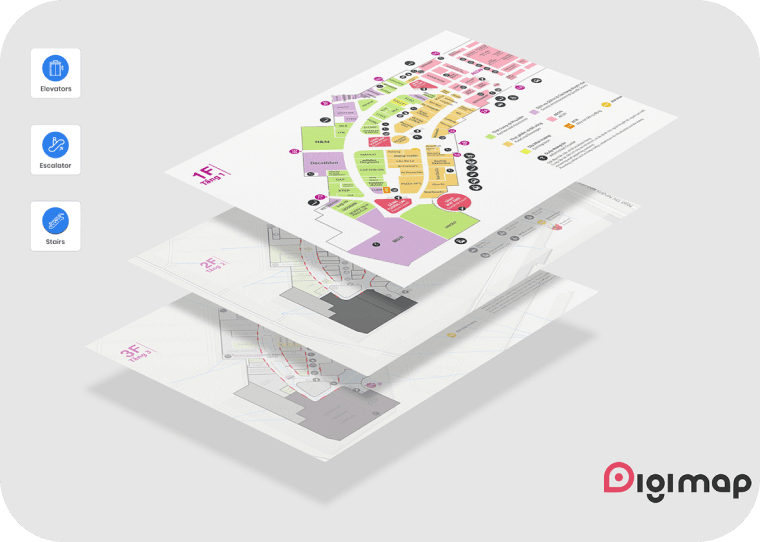
You walk into a five-story mall for the first time. Three hundred shops, four dining zones, two cinemas. You need one specific shoe store, but the static directory board in the lobby has small print and was last updated before the newest tenant opened. You ask security — he waves vaguely to the left. Fifteen minutes later, you still haven't found it. This is not an edge case; it is the daily reality in shopping malls that have not upgraded beyond paper.
"Seamless" does not mean frictionless perfection. In a context, seamless means a shopper never has to stop, ask for directions, or abandon a task mid-journey — whether they are looking for a store, a restroom, an ATM, or the exit closest to where they parked. Each unnecessary stop is a friction point. Accumulated friction makes shoppers leave earlier, spend less, and choose a different mall next time.
Research from East Asian retail markets shows shoppers spend 15–25% more in malls with digital wayfinding than in malls with only static directories. Mall loyalty app retention increases by 30% when the app integrates indoor maps and location-based notifications. These figures reflect actual shopper behavior when friction is removed — not marketing projections.
An indoor map is the technology layer that connects every touchpoint in that journey. Not a collection of isolated features, but a continuous infrastructure that accompanies the shopper from the moment they plan their visit to the moment they return home — and back again.
A static directory board — even a well-designed, well-placed one — has four structural limitations that better design cannot fix.
Now that Google Maps has trained people to know their exact position outdoors, the contrast when they walk through a mall entrance is sharper than ever. Expectations have shifted — building infrastructure needs to keep up.
An indoor map system is not just a wayfinding tool — it is a platform that connects every stage of the shopping journey, from planning a visit to coming back for the next one.
Most shoppers start planning before they leave home. They search for stores, check current promotions, and mentally map which areas they want to visit. A mall with an interactive map embedded in its website or app lets shoppers browse by category, locate specific stores, and save a personal list of places to visit — before arriving. Shoppers who arrive with a clear plan spend less time searching and have a higher purchase rate.
The parking lot is the first friction point and the most overlooked one. Getting lost before even entering the mall sets a negative tone for the entire visit. Integrating parking guidance into the indoor map — showing available spaces by floor, the closest entrance, and walking directions into the lobby — removes this friction entirely. Some systems also remember where a car was parked and remind the shopper on their way out.
This is the core stage. Combined with indoor positioning technology (BLE beacons, Wi-Fi, or UWB), shoppers see their exact location on the map — no guesswork, no trial and error. The system calculates the shortest route to any destination, routes around areas under repair, and suggests alternatives if an elevator is out of service. For shoppers with accessibility needs — wheelchair users, older adults — the system prioritizes step-free routes.
As a shopper passes a zone, the system can deliver a notification about a promotion at a nearby store — not a generic push, but a suggestion based on their shopping history and current location. This type of notification has a 30–40% higher click-through rate than standard push notifications, because it is relevant to the right person, at the right moment, in the right place. Flash sales, product demos, and event updates all appear directly on the map without the shopper having to seek them out.
Finding the payment counter, loyalty redemption desk, or the exit closest to where the car is parked — the same map handles all of it. No need to ask staff, no detours. A clean end to the visit creates a positive overall impression and increases the likelihood of a return trip.
Data from the visit — which stores were entered, how long the shopper spent in each area, which products were viewed but not purchased — becomes the input for retention strategy. Loyalty apps that integrate indoor maps show 30% higher retention rates than apps that only offer points accumulation, because the map is genuinely useful during the visit, not just after the shopper gets home.
O2O (Online-to-Offline) describes how retailers connect digital activity — ads, apps, websites — to physical in-store actions. An indoor map is the only layer that operates on both sides: pulling shoppers from online to offline (via an interactive map on the website), and measuring offline behavior with digital precision (via foot traffic data and location heatmaps).
When an online advertising campaign drives shoppers to the mall, the indoor map shows exactly how many of them actually reached the target store — rather than just counting ad clicks or app opens. That is data advertisers and tenants will pay a premium for.
Mall management benefits from the same indoor map system in parallel. Three of the most concrete operational gains:
The figures below reflect typical outcome ranges from real deployments in East and Southeast Asia. Specific results depend on building scale, integration depth, and operational strategy.
Before committing to hardware or software contracts, see a map that is already running in an active retail environment. You can request a demo to see what the system would look like for your building. When you have a clearer picture of the scope, contact us — Digimap will assess your existing infrastructure and propose an architecture matched to your building scale and business goals.